
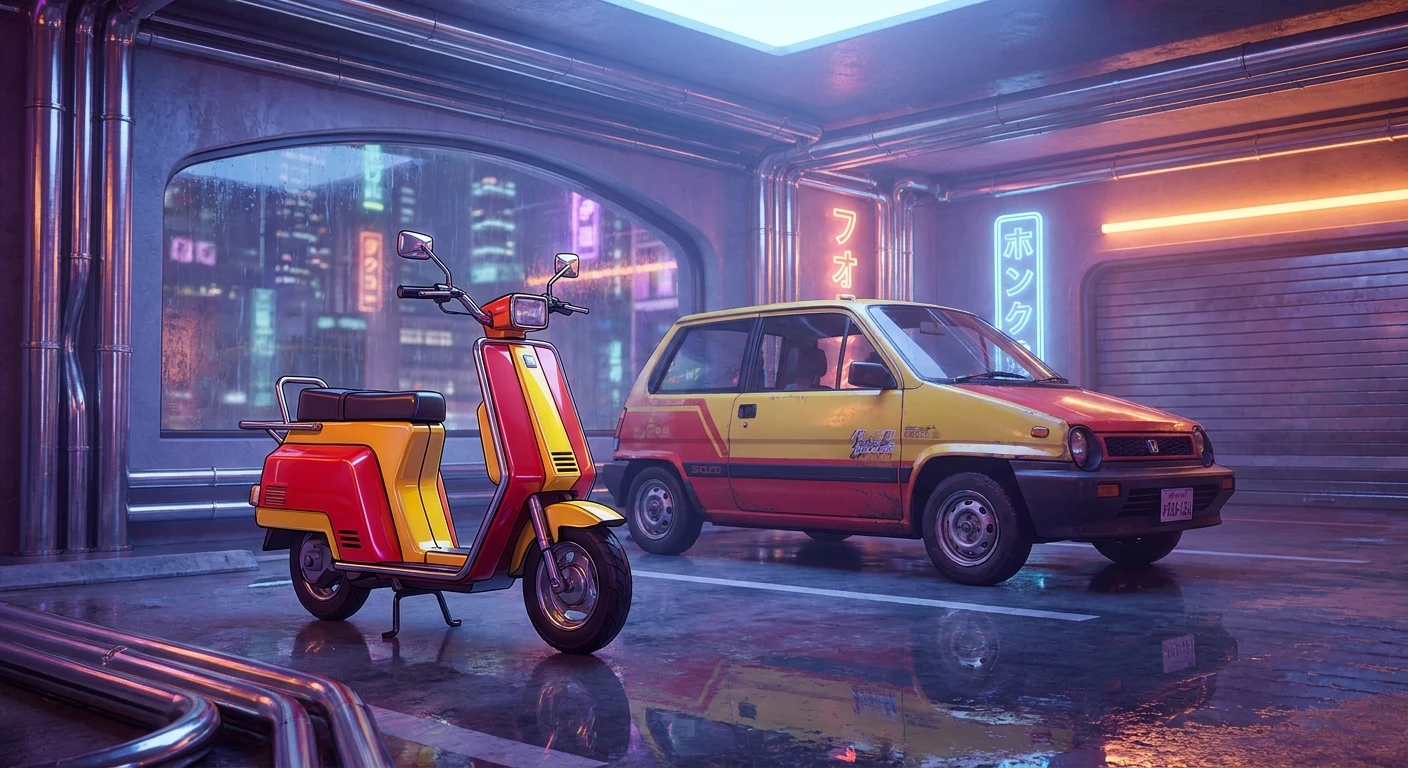
Understanding the Honda Motocompo Phenomenon
The Honda Motocompo stands out as one of the most fascinating engineering marvels of the entire 1980s automotive boom. Originally designed as a dedicated trunk bike (commonly known in Japan as a trabai) to fit perfectly inside the tiny subcompact Honda City car, this incredibly tiny folding scooter completely redefined urban mobility concepts. Unlike standard motorcycles or modern mopeds, its highly distinctive rectangular, box-like shape allowed the steering handlebars, the padded seat, and the side foot-pegs to fold entirely flush into its smooth plastic body. Think of it as a heavy, motorized briefcase that you can actually ride down the street. Introduced to the public in November 1981, it immediately captured the imagination of frustrated urban commuters who faced terrible traffic congestion and severely limited parking spaces every single day. By brilliantly combining a 49cc two-stroke engine with an incredibly compact physical footprint, automotive engineers created a highly unique mechanical solution for the frustrating last-mile commute, long before modern electric kick-scooters flooded city sidewalks. You park your car securely on the outskirts of the busy city, pop the rear trunk, lift out this heavy 45-kilogram machine, unfold the riding controls, and ride right up to your office door. It represents a boldly practical experiment in integrated vehicle design, aggressively pushing the boundaries of what a personal transport device could look like. Today, the massive global cult following around this miniature vehicle proves that brilliant mechanical packaging and quirky retro aesthetics simply never go out of style.
The Core Benefits and Practical Mechanics
Why exactly did the Honda Motocompo command so much global attention, and what makes it such a highly sought-after collector’s item right now? Here is a detailed breakdown of the tangible practical benefits and the inherent mechanical drawbacks of owning and operating this legendary microscopic motorcycle. Operating a vintage machine naturally requires a deep understanding of its unique physical characteristics.
Read also: Sharon Granites: The Ultimate Guide for Your Home; How to Build a black and gold brand; Ultimate Guide to Tabuai Fidow.
| Component Feature | Practical Advantage | Inherent Limitation |
|---|---|---|
| Folding Steering Mechanism | Fits seamlessly inside standard compact vehicle trunks | Moving mechanical parts require highly frequent lubrication |
| 49cc 2-Stroke Power Plant | Exceptionally easy to maintain with basic automotive hand tools | Low maximum speed strictly restricts any fast highway usage |
| Boxy Plastic Body Fairing | Effectively protects rider clothing from dark grease and hot oil | Vintage polymers are highly prone to severe cracking and sun damage |
The true lasting value of the classic scooter lies deeply in its dual nature as both a highly functional urban utility vehicle and an iconic piece of physical pop-culture art. For instance, dedicated classic vehicle collectors frequently display these brightly colored retro scooters right in their living rooms; their cleverly enclosed, cube-like design expertly prevents harsh oil and gas smells from leaking into the residential house. Another prime example is the currently booming custom car scene, where vintage Honda City owners consider possessing the exact matching trunk bike an absolute must-have retro accessory, dramatically increasing the main vehicle’s overall show value and historical authenticity at competitive automotive meets.
Here are the core functional highlights of the classic machine:
- Unmatched Portability Geometry: You simply fold the metal handlebars totally flat, firmly push the padded seat down into the chassis, and fold the side foot-pegs inward to quickly create a smooth, rectangular block that measures barely 118 centimeters in total length.
- Integrated Urban Commuting: By effectively bridging the frustrating physical gap between heavy automobile transit routes and strict pedestrian walking zones, clever riders completely bypass dense metropolitan gridlock entirely.
- Mechanical Operational Simplicity: The single-cylinder air-cooled engine cleverly uses a highly basic manual kick-start system and an automatic single-speed centrifugal clutch, meaning almost anyone can successfully operate it without possessing prior heavy motorcycle riding experience.
The absolute most ingenious part of the internal structural layout involves the highly secure fuel and two-stroke oil distribution systems. Automotive engineers specifically designed the internal liquid storage tanks with specialized locking sealing caps to actively prevent messy fluid leaks when the heavy scooter is laid completely horizontally in a bouncing car boot. However, maintaining that perfect fluid seal requires constant vigilance from the dedicated owner. If the tiny internal rubber gaskets naturally age, crack, and fail, transporting the vintage bike horizontally suddenly becomes a terribly messy ordeal. Despite these minor retro-maintenance quirks, the raw visual appeal of a perfectly restored, brightly colored trunk bike actively turning heads at a local downtown cafe simply cannot be overstated by any true vintage vehicle enthusiast.
Origins of the Trunk Bike Concept
The fascinating story truly begins in urban Japan during the late 1970s and early 1980s. Major Japanese cities rapidly experienced explosive population growth, quickly leading to severely congested metropolitan roads and an absolute critical shortage of daily parking spaces. Lead engineers at Honda sharply realized that standard automobiles alone could not effectively solve the growing urban mobility crisis. They creatively conceived the Trabai or trunk-bike concept. When they initially developed the brand-new Honda City subcompact car, they explicitly designed its rear luggage compartment to perfectly hold a companion two-wheeled vehicle. The resulting diminutive scooter was formally introduced to the Japanese domestic market in November 1981 alongside the main car. The aggressive marketing campaign even featured the wildly popular British ska band Madness, creating a highly playful, energetic brand image that deeply resonated with young drivers desperately looking for innovative transport solutions.
Evolution and Short-Lived Production
Despite the brilliant marketing strategy and the undeniable visual cuteness of the little vehicle, the initial domestic sales figures drastically fell short of official corporate expectations. The manufacturer confidently projected massive monthly sales of around 10,000 active units across domestic dealerships, but actual retail numbers hovered stubbornly around the 3,000 mark. Everyday consumers quickly found the 45-kilogram dry weight slightly too heavy to comfortably lift into a high car trunk on a daily commuting basis. Furthermore, while the physical pairing with the automobile was exceptionally clever, many practical buyers simply opted to purchase the main car without spending extra cash on the companion scooter. Consequently, active factory production only lasted a very brief historical window from 1981 strictly until 1983, with approximately 53,369 total units successfully built and officially sold. During this rather short production run, the factory proudly offered the little bike in three primary, highly vibrant colors: Daisy Yellow, Shetland White, and Caribbean Red, with bright yellow remaining the absolute most iconic historic hue.
Modern State and Cult Classic Status
Decades strictly after its official corporate discontinuation, the little folding scooter organically achieved legendary global status. Global pop culture heavily influenced this massive resurgence in popularity. Its highly prominent recurring appearance in the famous Japanese anime series You’re Under Arrest rapidly introduced the quirky vehicle to a massive global audience of young enthusiasts who had literally never seen one physically in person. Today, finding a fully functional original model with completely intact original plastic fairings is incredibly difficult and highly expensive. It has fully transitioned from a largely forgotten urban commuting tool strictly into a high-priced automotive collector’s centerpiece. Massive automotive museums and dedicated retro-futurism fans actively hunt for pristine, low-mileage examples, conclusively proving that sometimes, a consumer product simply arrives far too far ahead of its time to be fully appreciated by its contemporary consumer market.
Engineering the Folding Geometry
Creating a functional motorized vehicle that successfully collapses into a perfectly smooth, hard-shell rectangle requires intensely complex spatial geometry. The primary structural frame consists of heavy-duty, high-tensile steel tubing, specifically configured to create a massive inner structural void. This hollow center acts as a secure internal storage bay for the long steering column and the heavy metal seat post. When you physically turn the exterior locking knobs, the handlebars instantly detach from their rigid riding position and smoothly pivot downwards on precisely machined, aerospace-grade aluminum hinges. The greatest physical engineering challenge here involves strictly maintaining structural rigidity when the bike is fully deployed for aggressive riding. If the folding metal hinges possessed even a single millimeter of lateral play, the rider would quickly experience highly dangerous steering wobble at top speeds. Mechanical engineers brilliantly solved this dangerous issue by utilizing heavy-duty threaded locking collars that actively pull the folding joints tight against tapered metal mating surfaces, creating a completely solid, zero-tolerance mechanical connection that perfectly mimics a fixed, fully welded metal tube.
Thermodynamics of the Enclosed Engine
Effectively cooling a hot combustion engine that is wrapped entirely in solid, unventilated plastic paneling naturally poses a massive thermodynamic hurdle for any automotive designer. Standard lightweight mopeds heavily rely on rapid forward motion to actively push cold ambient air over exposed metal engine cooling fins. Because this specific scooter completely hides its entire power plant deeply inside a thick polymer shell, it absolutely requires a specially designed forced-air cooling system to actively prevent total catastrophic engine failure.
- Displacement Dynamics: A highly compact 49cc, AB12E specifically tuned air-cooled 2-stroke single-cylinder engine producing precisely 2.5 mechanical horsepower peaking at exactly 5,000 RPM.
- Forced Induction Cooling: A durable crankshaft-driven mechanical fan continuously draws ambient outside air through hidden front intake vents, pushing high-velocity cold air directly over the hidden metal cylinder head cooling fins.
- Thermal Deflection Shielding: The interior ABS plastic body fairings are carefully lined with specialized heat-reflective aluminum foil and thick fiberglass thermal shielding to heavily prevent the extremely hot exhaust pipe from physically melting the surrounding exterior bodywork.
- Leak-Proof Fluid Containment: The tiny mechanical carburetor and primary steel fuel tank strictly utilize a proprietary float-bowl internal drain mechanism and a hermetically sealed twisting gas cap, actively ensuring absolutely zero hydrostatic pressure leaks when fluid gravity shifts during completely horizontal storage.
By heavily manipulating static air pressure gradients directly within the tight plastic casing, the structural design perfectly ensures the tiny engine operates safely within a strict thermal envelope, actively preventing catastrophic overheating during heavily slow-moving traffic operations.
Day 1: Initial Assessment and Complete Visual Photography
Before physically touching a single rusty bolt, meticulously photograph every single square inch of the retro scooter using proper workshop lighting. Carefully document the exact factory routing of the metal throttle cables, the exact physical condition of the fragile plastic fairing tabs, and the current mechanical state of the heavy folding mechanisms. This massive visual baseline absolutely prevents costly reassembly errors later.
Day 2: Hazardous Fluid Drainage and Internal Tank Inspection
Safely drain the extremely decades-old stale fuel and highly degraded two-stroke engine oil into approved hazardous chemical waste containers. The internal structural steel gas tank is utterly notorious for rapidly accumulating severe internal rust flakes. Heavily use a specialized digital borescope camera to carefully inspect the deepest bottom metal seams. If severe physical oxidation is clearly present, immediately order a dedicated chemical rust-removal treatment kit.
Day 3: Careful Vintage Plastic Bodywork Removal
The large rectangular plastic outer shells are incredibly physically brittle after fully enduring forty years of harsh temperature changes. Strictly use dedicated soft plastic pry tools and practice extreme physical patience. Slowly loosen the rusty external retaining screws, taking maximum care not to accidentally snap the incredibly delicate internal mounting tabs. Store the rare vintage panels highly safely wrapped in thick heavy moving blankets.
Day 4: Carburetor Extraction and Deep Ultrasonic Cleaning
Carefully remove the tiny aluminum carburetor directly from the main engine block. It will almost certainly be heavily clogged with thick, hardened chemical varnish. Fully disassemble the microscopic internal brass jets and immediately place them securely in a heated professional ultrasonic cleaner completely filled with specialized automotive solvent to effectively break down the calcified hard fuel deposits.
Day 5: Folding Hinge Lubrication and Joint Articulation
Focus entirely on the complex physical steering and padded seat collapsibility functions. Heavily apply high-quality chemical penetrating oil directly to the heavy handlebar locking collars and the stiff seat post mechanical release button. Let the strong fluid perfectly soak for several long hours before gently working the tight joints back and forth until they physically operate smoothly without aggressively squeaking.
Day 6: Complete Electrical Continuity Testing
With a reliable, high-quality digital multimeter firmly in hand, comprehensively check the entire vintage 6-volt electrical system. Carefully test the magnetic stator output, the primary ignition coil resistance, and the physical condition of the original factory wiring harness. Immediately replace any physically cracked or totally brittle copper wires that could easily cause a dangerous electrical short circuit violently against the bare metal frame.
Day 7: Sourcing Rare Authentic Replacement Parts
Carefully compile a highly comprehensive master list of fully missing, severely worn, or fundamentally broken physical components based entirely on your previous six days of highly intensive workshop inspection. Spend major time thoroughly scouring Japanese domestic auction sites, highly specialized vintage motorcycle forums, and global classic vehicle swap meets to effectively locate perfect authentic replacement pieces.
Debunking Common Historical Misconceptions
Myth: The heavy scooter was purposely designed to be easily carried strictly around the city like a lightweight business briefcase by a single hand.
Reality: Weighing a massive 45 kilograms (nearly 100 pounds) when fully fueled, it is fundamentally far too heavy for any normal person to comfortably carry like standard airport luggage. The highly iconic rectangular shape was strictly intended for stacking neatly flat in a carpeted car trunk, absolutely not for physically carrying down the pedestrian sidewalk.
Myth: You can still easily buy brand-new factory plastic body panels directly from the manufacturer today.
Reality: The original vehicle manufacturer permanently ceased active production of the specialized bodywork several decades ago. Modern owners must heavily rely on extremely expensive used parts, painstaking manual fiberglass repairs, or entirely modern aftermarket fiberglass custom reproductions.
Myth: It is perfectly street legal and totally safe to actively ride on modern fast highways.
Reality: With a low top speed of strictly only 30 km/h (roughly 18 mph) and a tiny 49cc engine, it entirely lacks the massive physical power and strict legal vehicle classification to safely or legally operate on any major highways; it is strictly an urban neighborhood transit vehicle.
Myth: The tiny engine heavily requires a highly complex pre-mixed chemical fuel solution.
Reality: It brilliantly features a dedicated automatic oil injection system that automatically mixes the required two-stroke oil directly with standard regular gasoline from a totally separate internal liquid reservoir.
Myth: It is totally impossible to physically rebuild the internal engine today due to rare parts.
Reality: The specialized AB12E internal engine actually shares numerous basic internal mechanical components with other highly popular compact scooters from the exact same historical era, naturally making general mechanical engine rebuilds surprisingly straightforward for mechanics.
FAQ: Frequently Asked Questions
How fast does the engine actually go?
Under totally optimal physical conditions with a highly light rider, it mechanically tops out at approximately 30 kilometers per hour safely.
Can the suspension support a heavy rider?
The main structural steel frame is surprisingly physically robust, but naturally heavier riders will significantly mathematically reduce overall mechanical acceleration and steep hill-climbing ability.
What specific kind of fuel does the tank use?
It exclusively uses standard modern unleaded gasoline, while a completely separate hidden internal tank holds standard 2-stroke automotive engine oil.
Does operating it require a special motorcycle license?
Heavily depending on strict local legal jurisdiction, its tiny 49cc engine classification often legally allows it to be safely ridden with just a standard basic car driver’s license.
Is the collapsible frame difficult to fold up manually?
Absolutely no, once you perfectly understand the specific locking mechanism, physically collapsing the metal handlebars and padded seat entirely takes less than sixty physical seconds.
Can I safely store the machine inside my residential apartment?
Yes, the hermetically sealed fuel and thick oil caps highly effectively allow it to be safely stored completely indoors without emitting strong dangerous gasoline odors.
Where can I reliably find an authentic model for sale?
Dedicated Japanese domestic market physical import brokers and highly specialized classic classic vehicle digital auction websites remain the absolute best viable sources.
Conclusion and Final Thoughts
The globally enduring historical legacy of the highly iconic Honda Motocompo folding trunk bike serves as a brilliant, physical reminder of an amazing automotive era when massive corporate automotive engineers truly dared to dream vastly differently. Its completely flawless mechanical integration of practical physical form, urban transit function, and sheer riding fun absolutely makes it a lasting masterpiece of 1980s industrial product design. Whether you are actively hunting for your absolute first challenging vintage vehicle project or simply visually admiring its quirky aesthetic brilliance, this tiny incredible machine continuously continues to rapidly capture automotive hearts globally. Boldly share this comprehensive guide with your fellow dedicated gearheads and quickly start physically planning your ultimate retro garage build today!